Adaptive Scheduling and Resource Management for Real-Time Embedded GPU Systems
Embedded GPUs support computationally intensive applications in autonomous vehicles, drones, robotics, and virtual reality. These applications must meet timing requirements despite changing inputs, interference from concurrent tasks, and limited computing resources.
Traditional GPU scheduling relies heavily on offline execution-time estimates and fixed resource allocations. These approaches can miss deadlines when workloads change or leave GPU resources underutilized when estimates are overly conservative.
This research develops adaptive scheduling and resource management techniques for soft real-time embedded GPU workloads. The work investigates three complementary directions:
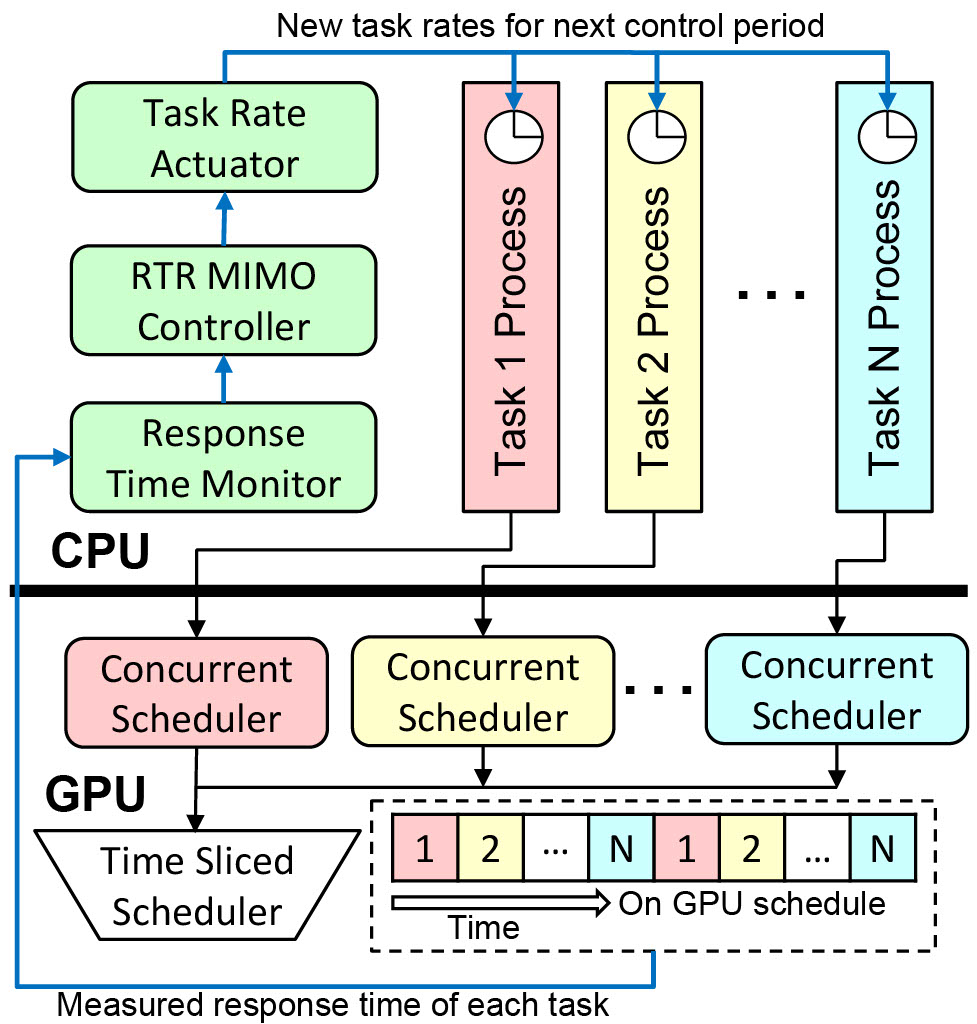
Feedback-controlled task-rate adaptation. Dynamically adjusting task invocation rates regulates the response time ratio (RTR), defined as a task’s response time divided by its period. A multi-input multi- output (MIMO) controller accounts for interference among concurrent tasks.
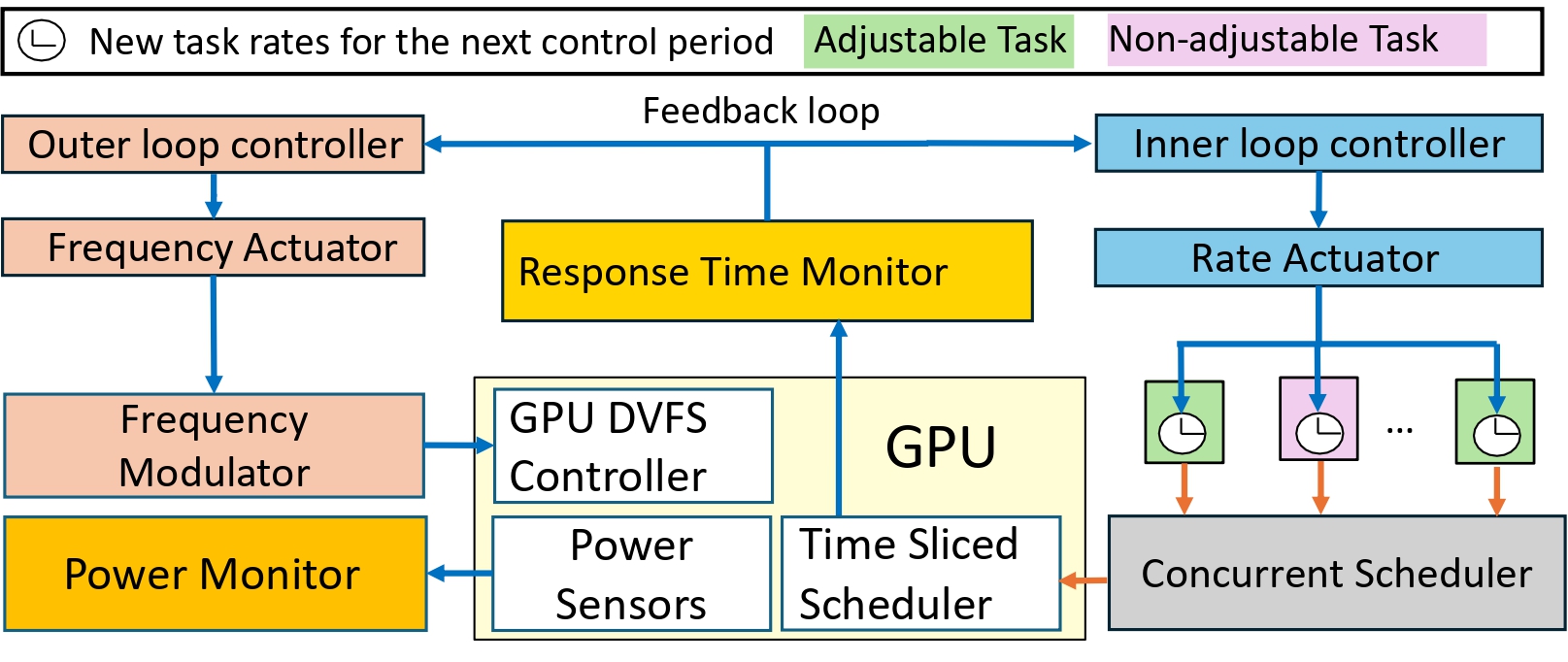
Coordinated rate adaptation and frequency scaling. Combining task-rate control with GPU frequency scaling addresses the limitations of bounded task rates and reduces unnecessary power consumption.
Dynamic GPU resource allocation. Adjusting streaming multiprocessor (SM) allocations among concurrent tasks enables spatially shared GPUs to respond to workload changes.
Evaluations on physical GPU platforms demonstrate improvements in runtime adaptability, task timeliness, resource utilization, and power efficiency. Together, these contributions reduce dependence on fixed scheduling decisions and support more efficient GPU execution under changing workloads.
Developed FC-GPU, a feedback-control scheduling framework that dynamically adjusts the invocation rates of periodic GPU tasks. Its MIMO controller captures interference among tasks and regulates their RTRs, reducing deadline violations under runtime workload changes.
Developed PowerGPU, a two-tier control framework that coordinates task-rate adaptation with GPU frequency scaling. The inner loop regulates individual task RTRs, while the outer loop adjusts frequency to regulate average RTR. In the reported comparison, PowerGPU reduces average GPU power consumption by 29.4% relative to FC-GPU while maintaining zero deadline misses.
Developed DySM, a feedback-control framework that dynamically adjusts SM allocations among concurrent tasks on spatially shared GPUs. Its MIMO controller coordinates resource allocation using measured task response times, reducing deadline violations compared with static allocation approaches under changing workloads.
References
2026
ICCD
PowerGPU: Power-aware Feedback Control GPU Scheduling in Real-time Embedded Systems
Srinivasan Subramaniyan, Blake Morse, and Xiaorui Wang
@inproceedings{PowerGPU,author={Subramaniyan, Srinivasan and Morse, Blake and Wang, Xiaorui},title={PowerGPU: Power-aware Feedback Control GPU Scheduling in Real-time Embedded Systems},year={2026},publisher={IEEE},url={},booktitle={},}
ECRTS
DySM: Dynamic Scaling of GPU Streaming Multiprocessor in Spatially Shared Real-Time Embedded GPU Systems
Srinivasan Subramaniyan and Xiaorui Wang
In 38th European Conference on Real-Time Systems (ECRTS), 2026
@inproceedings{DySM,author={Subramaniyan, Srinivasan and Wang, Xiaorui},title={DySM: Dynamic Scaling of GPU Streaming Multiprocessor in Spatially Shared Real-Time Embedded GPU Systems},year={2026},publisher={Schloss Dagstuhl -- Leibniz-Zentrum für Informatik},url={https://doi.org/10.4230/LIPIcs.ECRTS.2026.16},booktitle={38th European Conference on Real-Time Systems (ECRTS)},doi={10.4230/LIPIcs.ECRTS.2026.16},}
2025
EMSOFT
FC-GPU: Feedback Control GPU Scheduling for Real-Time Embedded Systems
Srinivasan Subramaniyan and Xiaorui Wang
ACM Transactions on Embedded Computing Systems, Sep 2025
Recieved the Outstanding Paper award for FC-GPU at ESWEEK 2025
GPUs have recently been adopted in many real-time embedded systems. However, existing GPU scheduling solutions are mostly open-loop and rely on the estimation of worst-case execution time (WCET). Although adaptive solutions, such as feedback control scheduling, have been previously proposed to handle this challenge for CPU-based real-time tasks, they cannot be directly applied to GPUs, because GPUs have different and more complex architectures and so schedulable utilization bounds cannot apply to GPUs yet. In this article, we propose FC-GPU, the first feedback control GPU scheduling framework for real-time embedded systems. To model the GPU resource contention among tasks, we analytically derive a multi-input–multi-output (MIMO) system model that captures the impacts of task rate adaptation on the response times of different tasks. Building on this model, we design a MIMO controller that dynamically adjusts task rates based on measured response times. Our extensive hardware testbed results on an NVIDIA RTX 3090 GPU and an AMD MI-100 GPU demonstrate that FC-GPU can provide better real-time performance even when the task execution times significantly increase at runtime.
@article{10.1145/3761812,author={Subramaniyan, Srinivasan and Wang, Xiaorui},title={FC-GPU: Feedback Control GPU Scheduling for Real-Time Embedded Systems},year={2025},issue_date={September 2025},publisher={Association for Computing Machinery},address={New York, NY, USA},volume={24},number={5s},issn={1539-9087},url={https://doi.org/10.1145/3761812},doi={10.1145/3761812},journal={ACM Transactions on Embedded Computing Systems},month=sep,articleno={155},numpages={25},keywords={GPU scheduling, real-time systems, embedded systems, feedback control},}